

The 70 percent rule is a familiar shortcut for screening a potential flip, and it does that job well. The trouble starts when it stops being a filter and becomes the price. If you’ve run enough deals, you’ve seen the rule say yes to a flip that lost money and no to one that would have paid. This guide covers the formula, then the full deal math behind it, so you can see where the rule is accurate, where it overpays, and where it leaves money on the table.
The short answer: The 70 percent rule caps your offer at 70% of after-repair value (ARV) minus repairs: Maximum offer = (ARV × 0.70) − repair costs. It prices every cost except rehab as one lump, 30% of ARV. Your real ceiling depends on your actual rehab scope, hold time, financing cost, selling costs, and the profit you need. The rule screens a deal. It doesn’t price it.
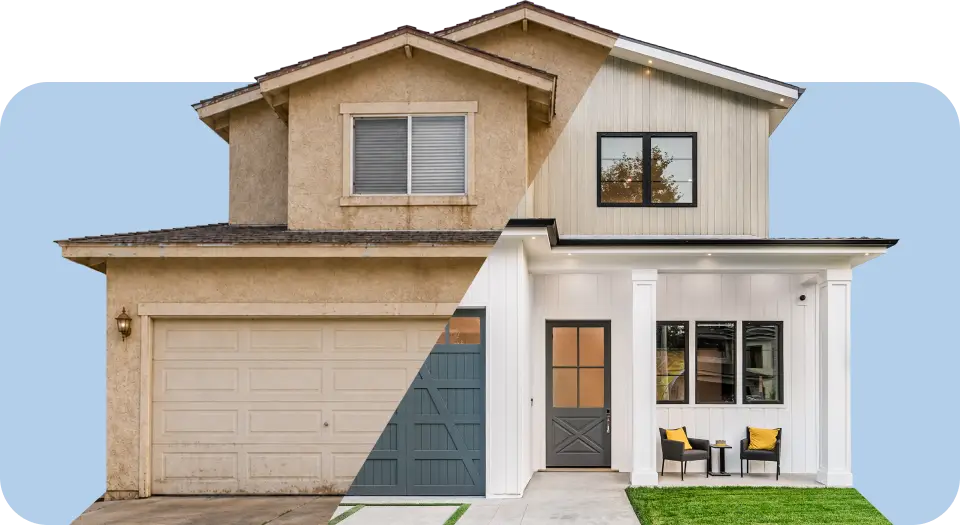
What is the 70 percent rule? A simple definition
The 70 percent rule is a house-flipping screen that caps your maximum offer at 70% of a property’s ARV minus repair costs. The 30% you hold back is meant to cover financing, holding costs, closing costs, commissions, contingency, and your profit, all at once.
That lump is the strength and the weakness of the rule. It lets you screen a lead quickly. It also assumes every deal carries about the same cost and takes about the same time, and the deals you actually do rarely line up that neatly.
How do you calculate the 70 percent rule?
Maximum Offer = (ARV × 0.70) − Repair Costs
Multiply ARV by 0.70, then subtract the repair budget. On a $400,000 ARV with $60,000 in repairs, the maximum offer is $220,000. Both inputs are estimates, so the output is only as reliable as your comps and your scope.
- ARV is the after-repair value, based on recent sold comparables, not asking prices.
- Repair costs are the full budget to reach that finished condition.
What does the 70% rule leave out?
It leaves out everything that differs from deal to deal. A full purchase-price ceiling starts from the exit and works backward, subtracting each cost you expect to carry:
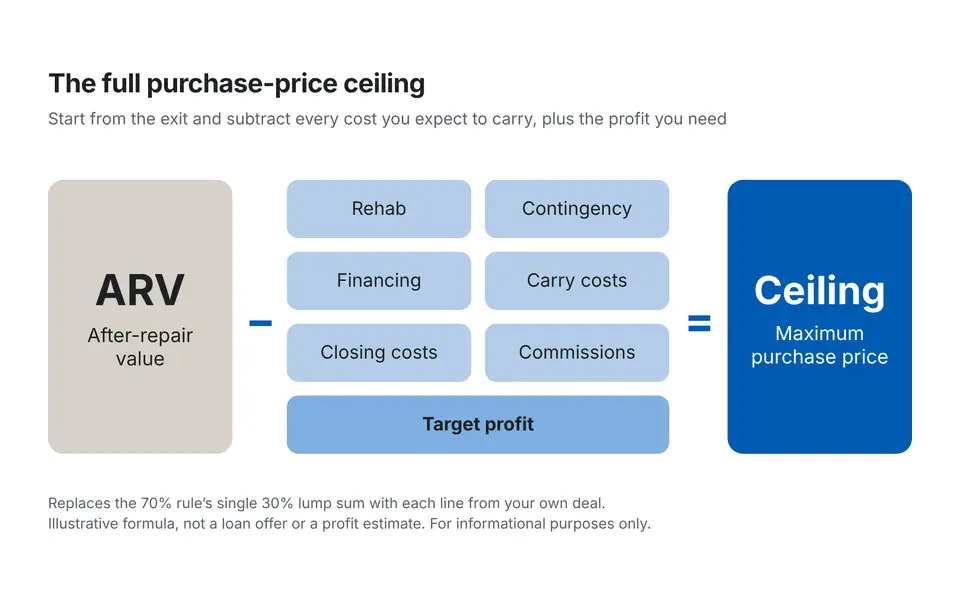
The target profit is yours to set, as a dollar figure, a share of ARV, or a return on cash invested. The 70% rule never asks. Whatever profit is left after the lump sum is simply the profit you get, and that can be more or less than you need.
The next section runs the same $400,000 ARV through three deals to show how far the two methods can drift apart.
What is an example of the 70% rule?
Start with Michelle, an investor who finds a dated three-bedroom where renovated homes sell for $400,000. Her contractor prices the rehab at $60,000, so the rule gives a maximum offer of $220,000. Now compare her deal with two others at the same ARV, using the full math. All three assume a $60,000 target profit, $8,000 in closing costs, and agent commissions of 5% of the sale price.
| Deal A: Michelle, 6-month hold | Deal B: heavy scope, 9-month hold | Deal C: cosmetic, 3-month hold | |
|---|---|---|---|
| ARV | $400,000 | $400,000 | $400,000 |
| Rehab budget | $60,000 | $90,000 | $25,000 |
| Contingency | $6,000 | $13,500 | $2,500 |
| Financing cost over the hold | $20,000 | $30,000 | $10,000 |
| Taxes, insurance, utilities | $6,000 | $9,000 | $3,000 |
| Closing costs, buy and sell | $8,000 | $8,000 | $8,000 |
| Commissions at 5% | $20,000 | $20,000 | $20,000 |
| Target profit | $60,000 | $60,000 | $60,000 |
| Full-math ceiling | $220,000 | $169,500 | $271,500 |
| 70% rule maximum offer | $220,000 | $190,000 | $255,000 |
| Rule minus ceiling | $0 | +$20,500 | −$16,500 |
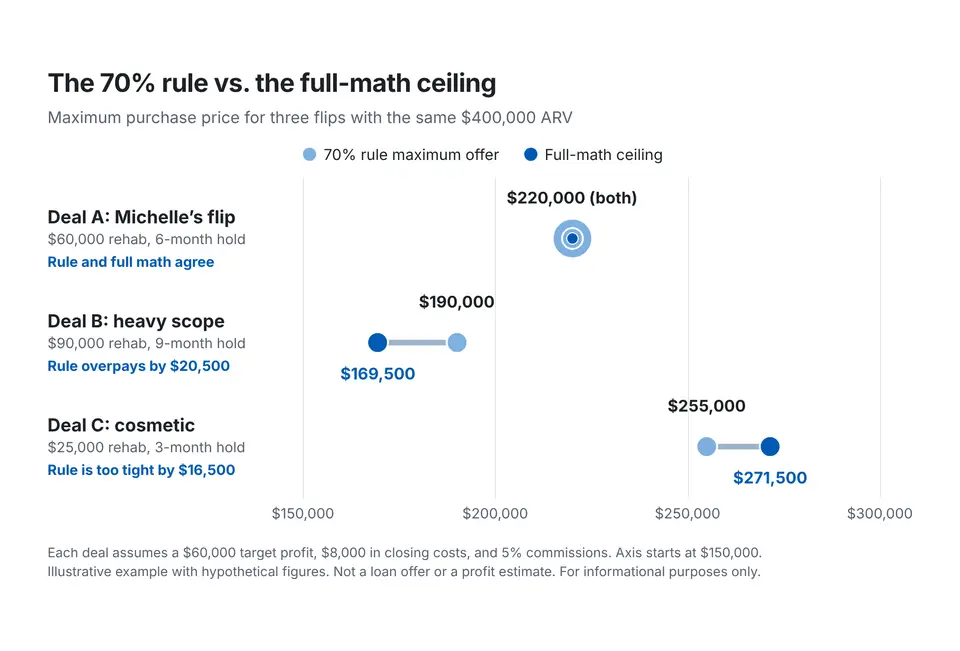
Deal A is where the rule works. The rule and the full math land on the same $220,000, because Michelle’s costs happen to match what the 30% assumes. Deal B is where it overpays. A deeper scope and three more months of carry push the ceiling to $169,500, so the rule would have you paying about $20,500 too much. Deal C is where it’s too tight. A light rehab and a short hold support $271,500, which means a strict 70% would have you walk from a deal that clears your target.
Margins leave little room for that error. According to ATTOM’s Q2 2026 Home Flipping Report, the typical gross profit on a flip was $60,526, a typical profit margin of 21.5%, down from 27.6% a year earlier. Those figures come before rehab, financing, and holding costs. ATTOM notes that flipping veterans estimate rehab and other expenses typically run 20% to 33% of ARV. With a cushion that small, the price you pay going in decides whether you make money.
What moves the ceiling most?
Three inputs do most of the damage, and the 70% rule treats none of them separately.
- Time. In Deal A, financing and carry cost about $4,300 a month. Every month past plan comes straight out of the ceiling, so permit delays and a slow sale matter more than most flippers budget for.
- ARV error. A $20,000 miss on ARV moves the 70% rule number by $14,000. In this example, with the profit target held at $60,000 and commissions at 5%, it moves the full ceiling by $19,000, because only the commissions shrink with the sale price. A percentage rule understates how fast a soft ARV hurts.
- Scope. A deeper rehab raises the budget and the contingency and usually the hold, so its cost compounds in three lines at once.
Ready for Financing?
Tell us about your project and get a personalized estimate in minutes.
When should you break the 70% rule?
Break it when you can point to a specific line in the budget that changes. If the reason is a feeling about the market, hold the line. These are the cases where the full math usually disagrees with the rule.
On a light scope and a short hold
A cosmetic rehab with firm comps carries less contingency, fewer carry months, and less financing cost. That is Deal C. The rule is too tight here, and the full math tells you by how much. That higher ceiling depends on a verified scope, a realistic schedule, and a supported resale estimate.
On heavy scope or a long hold
Opening walls, moving plumbing, structural work, or a long permit timeline all push the ceiling below the rule. That is Deal B. On these deals the right move is often to price off the full math and expect to land well under 70%.
When the ARV range is wide
Thin or mixed comps can support a range of values, not one number. Underwrite to the low end of that range. The rule gives you no way to express uncertainty, so the discipline has to come from you.
When you have your own crew or a license
A crew and a license are real advantages, but they belong in the numbers, not in the percentage. A lower repair cost belongs on the rehab line, and commissions you won’t pay belong on the commission line. If the savings are real, the ceiling rises on its own, and you can defend the price to a partner or a lender because you can show where each dollar came from.
Does the 70% rule actually work?
The 70 percent rule works as a screen. It fails as a price when the inputs are weak, because a confident percentage built on a soft ARV or a rough scope feels like protection and isn’t. To protect the inputs:
- Pull real comps. Use sold prices, not asking prices, within a tight radius and a recent window, and adjust for condition.
- Get a line-item bid in writing and walk the property with the contractor before you commit.
- Build the schedule backward from permits, inspections, and draw timing, so the hold in your model is a real number.
- Scale contingency to scope. A light cosmetic job and a gut rehab don’t carry the same unknowns.
The percentage is the easy part. The inputs are where deals are won and lost.
Where does financing fit in the 70% rule?
Financing is a line in the math, not a gate in front of it. The cost of capital lowers your ceiling. Funding or draw delays can also extend the project timeline, and a longer timeline adds carry and financing cost. So the questions that matter are practical: how long the loan takes to close, how quickly rehab draws fund after an inspection, and which costs you carry yourself.
Archwest underwrites the deal and the exit: the purchase price, the rehab budget, and the ARV, alongside credit, KYC, and your track record. The 70% rule is a tool for your own offer, not a lending requirement. A complete file helps a fix and flip loan move quickly, so bring the contract, the line-item budget, and the comps behind your ARV. Get a fix and flip loan estimate and we’ll look at the numbers with you.
70 percent rule FAQs
The formula and the basics
What is the formula for the 70% rule?
Maximum offer = (ARV × 0.70) − repair costs. Multiply the after-repair value by 0.70, then subtract your repair budget. The result is a screening ceiling, not a price.
What does the 30% in the 70% rule cover?
The 30% you hold back covers financing, closing costs on both ends, holding costs, commissions, contingency, and your profit. It treats them as one lump, which is why the rule can miss on a deal with unusual costs or timing.
How is the 70% rule different from ARV?
ARV is one input into the rule. It’s the projected after-repair sale price, and the rule uses it to set your maximum offer. An inaccurate ARV breaks the rule before the percentage comes into play.
Applying the rule
Is the 70 percent rule outdated?
It’s still a useful first filter in 2026. With ATTOM reporting a typical profit margin of 21.5% in Q2 2026, before rehab and carrying costs, there’s little room for a rule of thumb to be wrong. Use it to screen, then price the deal with the full math.
Should you ever pay more than 70%?
Sometimes, when the full math supports it. A light scope, a short hold, and firm comps can put your ceiling above the rule. Show it in the budget lines first, and don’t stretch the percentage on a hunch.
Where do loan costs go in the 70% rule?
They sit inside the 30% hold-back, along with everything else. For a more precise answer, break financing out as its own line, as in the example above, so you can see what a longer hold or a different structure does to your ceiling. For how the product works, see our guide to fix and flip loans.
How should you set a target profit?
Pick the measure your capital partners use, whether that’s dollars, a percentage of ARV, or a return on cash invested. Hold it constant when you compare deals, then adjust it for each project’s risk, duration, and capital committed. A defined target is what turns the ceiling into a decision instead of an estimate.
Sources
The 70% rule is a rule of thumb, not underwriting. Figures in the example are hypothetical. Market data below should be checked against your own comps.
